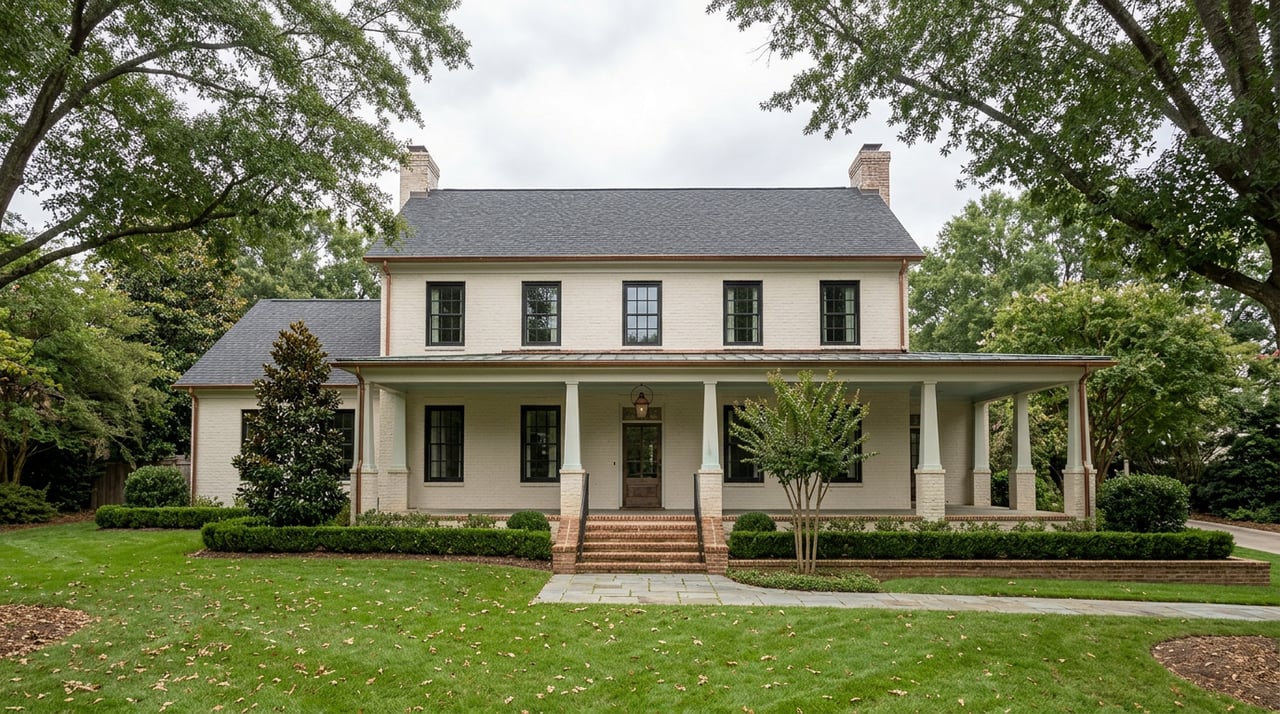
Myers Park's Historic Status Won't Stop the House Next Door From Being Torn Down
September 24, 2026
September 24, 2026
If a historic district exists to protect old houses, why is a five-bedroom spec estate going up two lots from a 1920s Tudor on one of Myers Park's most photographed streets? The house being replaced isn't in foreclosure. It isn't falling down. It's simply on a parcel where nothing legally required it to survive.
That contradiction is the whole story for anyone comparing Myers Park against Charlotte's other legacy neighborhoods. The National Register plaque, the century-old oaks, the Colonial Revival and Tudor Revival architecture, all of it is real. What it isn't is a permit requirement. Myers Park's protection runs through a different, quieter system than the one buyers assume is in place, and that system explains a price pattern you can see on any portal but rarely get explained.
Charlotte has two very different categories of "historic," and they get used interchangeably in casual conversation even though only one of them comes with teeth.
The city has designated six local historic districts by City Council action: Dilworth, Fourth Ward, Hermitage Court, Plaza-Midwood, Wesley Heights, and Wilmore. In those six, any exterior change visible from a public right of way, including a full demolition, requires a Certificate of Appropriateness from the Charlotte Historic District Commission before the county will issue a permit. That review is a real gate. A homeowner or builder in Dilworth has to bring plans to the commission and get a yes before a wrecking crew shows up.
Myers Park was added to the National Register of Historic Places, which is an honor and a record, not a local ordinance. The Wikipedia entry on the neighborhood documents 670 contributing buildings recognized for their architecture and history. What that listing does not do is trigger Charlotte Historic District Commission review before a house comes down. That distinction is confirmed directly by a Charlotte permitting guide that lays out the city's six local districts by name and notes plainly that Myers Park's National Register status doesn't carry the same automatic review.
So the question isn't whether Myers Park is historic. It clearly is. The question is what happens on the ground when someone wants to tear a house down, and the honest answer is: not much, unless something else on that specific parcel says otherwise.
That "something else" has a name: the Myers Park Homeowners Association, formed in 1970 for the explicit purpose of fighting demolition. The backstory matters. Charlotte's first comprehensive zoning ordinance in 1962 rezoned the old streetcar suburbs, Myers Park included, for offices, stores, and apartments. Houses along Queens Road started falling in the early 1960s, replaced not by neglect but by posh apartment buildings, because the neighborhood was still desirable enough to redevelop. Homeowners organized in response, and the association succeeded in getting much of the neighborhood downzoned to discourage further teardowns.
It didn't stop the practice entirely. More than two dozen early dwellings have come down since 1970 despite the association's advocacy, according to the neighborhood's own National Register documentation. The organization is still active, membership is voluntary, and the tools it has are persuasion, downzoning advocacy, and whatever deed restrictions happen to be recorded on individual lots, covering things like setbacks and tree preservation. None of that is a citywide ordinance. It's parcel-by-parcel paperwork, and it varies from one recorded deed to the next.
That is the real mechanism. In Dilworth, protection is uniform because it's a government process applied to the whole district. In Myers Park, protection is a patchwork, present on some lots and absent on others, depending on what was recorded decades ago and whether that lot's covenant addresses demolition at all.
If that patchwork theory is right, the sales data should look less like one coherent market and more like two markets sharing a zip code. It does.
Over the trailing 12 months, single-family sales in Myers Park ranged from roughly $700,000 to $6.6 million, with a median of only six to seven days on the market, according to Canopy MLS figures compiled by a local brokerage's neighborhood report. Lot sizes in that same window ran from 0.12 to 0.98 acres, with a median around 0.3 acres. Home sizes ranged from 600 to 7,400 square feet.
The detail that ties it together is the build-year spread: 1920 to 2026, with a median year built of around 1997. Myers Park was platted in 1911. A median build year nearly nine decades later means half the homes standing in the neighborhood today were constructed after most of its architectural reputation was already established. That's not incidental. It's the fingerprint of ongoing replacement, not preservation.
Zillow's home value index put the average Myers Park home value at roughly $1.42 million as of June 2026, up about 3 percent over the prior year. That average sits comfortably inside the $700K to $6.6M range, which tells you the range itself is doing the real work. A $700,000 sale is very likely a smaller, older home on a standard lot, possibly one without a demolition-relevant covenant attached. A $6.6 million sale is very likely new construction on a premium lot, built by one of the custom firms active in the neighborhood, names like Simonini, Saussy Burbank, Alenky Signature Homes, and DuBose Custom Homes show up repeatedly in current listings. Charlotte's citywide median sale price sits well under half a million dollars as of mid-2026. Myers Park isn't expensive in one smooth gradient. It's expensive in two separate ways that happen to share a mailing address.
For a buyer cross-shopping Myers Park against Dilworth or Plaza-Midwood, the practical takeaway isn't that one neighborhood is better protected than another in some abstract sense. It's that the kind of protection is different, and that difference changes what due diligence looks like.
In Dilworth, Fourth Ward, or Plaza-Midwood, a buyer can reasonably assume any exterior change to a neighboring historic property needs commission sign-off, because that's how the local district ordinance works citywide. In Myers Park, that assumption doesn't hold. The house next door, or across the street, may or may not carry a covenant that limits what a future owner can do to it. Finding out requires actually looking.
Before writing an offer on a Myers Park property, or evaluating what might happen to the lot next to one, it's worth checking:
None of this makes Myers Park a riskier place to buy. It makes it a neighborhood where the protective story is more layered than the plaque at the entrance suggests, and where a buyer who understands that layering is better positioned to judge what they're actually purchasing: a house, a lot, or both.
Does living in Myers Park mean my property is protected from a teardown next door? Not automatically. Myers Park's National Register status doesn't require Charlotte Historic District Commission review before a neighboring demolition, unlike Dilworth, Fourth Ward, Hermitage Court, Plaza-Midwood, Wesley Heights, or Wilmore. Whether a specific neighboring lot is protected depends on deed restrictions recorded on that parcel, which a title search can confirm.
Why does Myers Park have such a wide price range compared to a neighborhood like Dilworth? Because the price range reflects two different products under one neighborhood name: older homes on standard lots and newly built estates on premium lots, without a uniform local-district review process to keep that gap narrower. Districts with mandatory Certificate of Appropriateness review tend to see steadier, more predictable price bands because the pace and character of redevelopment is more tightly governed.
If you're weighing Myers Park against Charlotte's other historic neighborhoods and want to understand what a specific address's covenant history actually allows, that's exactly the kind of due diligence Theresa Pavone and the Next Move Carolinas team walk clients through before an offer goes in. Let's Connect — Schedule Your Consultation.



Experience a personalized journey to your dream home with Theresa Pavone. Every step, from consultation to closing, is thoughtfully curated to meet your unique vision of luxury living.