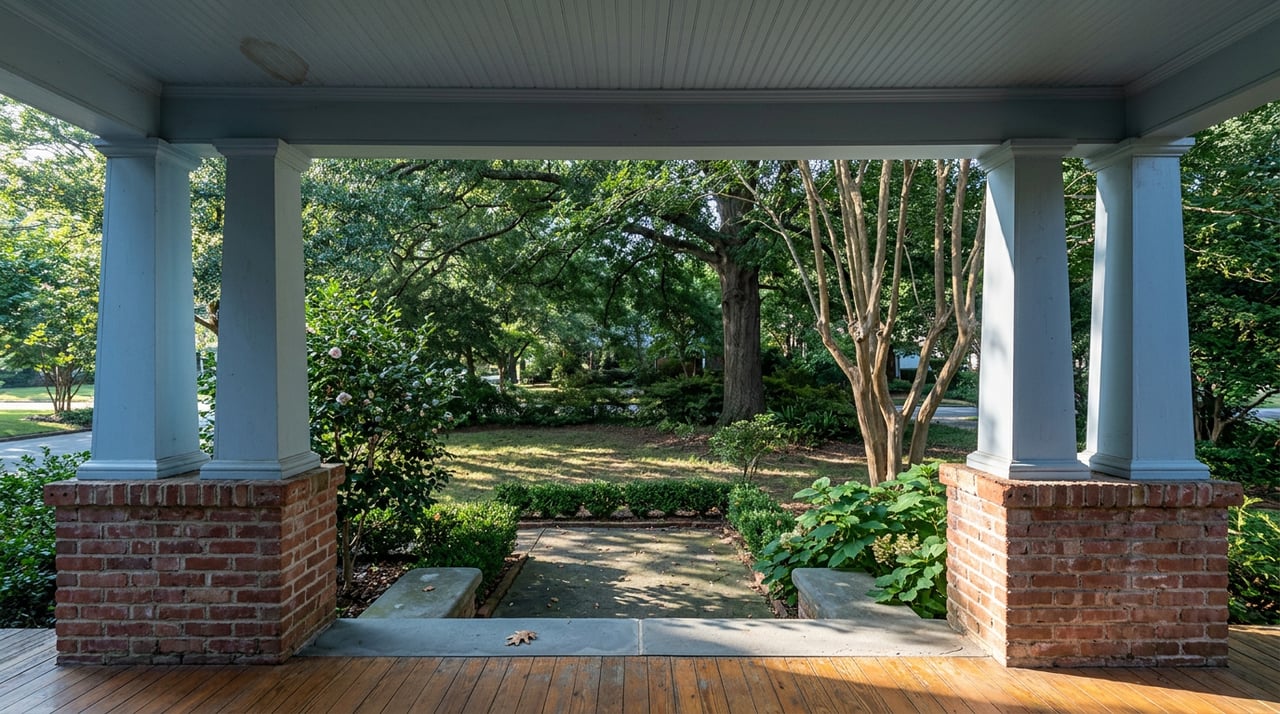
The Freedom Park Detour Ended in July. The Real Change to This Park Is Still Ahead.
September 10, 2026
September 10, 2026
If you've walked, run, or biked the Little Sugar Creek Greenway near Freedom Park any time in the last two years, you know the detour. The short stretch that used to cut past Discovery Place Nature has been fenced off since the building came down in early 2024, forcing everyone north through Freedom Park itself to get around it. That detour ended this July. The fence came down along a roughly 765-foot section running from near Princeton Avenue up to the first pedestrian bridge over the creek, and greenway regulars finally got their straight line back.
Here's what most people walking that stretch don't realize: the greenway reopening wasn't the finish line. It was the warmup act. The building on the other side of that fence, the one still under construction, is about to change how this whole park works in a way that has nothing to do with otters or treetop walks, even though those are the parts everyone's talking about.
The original nature museum on this site opened in the late 1940s, the work of a retired science teacher named Laura Owens who wanted kids to get their hands on the animals and plants they'd only encountered in books. It stood on that spot in Dilworth for more than seventy years. And for all seventy of them, its front door faced the street.
That sounds like a small detail. It wasn't. It meant that for seven decades, a building sitting inside one of Charlotte's most-used parks gave nothing back to the people walking past it. You could loop the whole park and never have a reason to look twice at the museum unless you were already headed there with a ticket in hand. The building and the park existed next to each other, not with each other.
The new Charlotte Museum of Nature, a partnership between Mecklenburg County, which owns the property, and the nonprofit Discovery Place, which has run the museum programming since the 1940s, flips that. The entrance now opens directly into Freedom Park instead of onto Sterling Road. Discovery Place president and CEO Catherine Wilson Horne has described the layout as filling roughly 13 acres around a 26,000-square-foot building, more than double the footprint of the structure that came down.
The part that matters for anyone who uses this park regularly, whether or not they ever buy a museum ticket, is the Frog Bog. It's a small pond tucked into a Woodland Garden at the base of the new building, and it's designed to function as the museum's front yard: free, open, and accessible to any Freedom Park visitor whether they walk through the museum doors or not. For the first time since this building has existed, there's a reason to stop here that costs nothing and requires no admission.
The renderings have been circulating for over a year now, but the specifics are worth having straight, because the scope has grown considerably since the county first signed off on it. Mecklenburg County approved an initial $16 million for the project. By 2023, that number had already climbed to $36 million. As of October 2025, the total project cost stood at $65 million, and the museum still needed to raise roughly $8 million to close the gap, the most recent public figure on that fundraising status.
What that money is building:
None of this is new information if you've been half-watching the construction fence. What's less discussed is the timing gap. As of June 2026, the museum's own site still described the opening as anticipated sometime in 2026 without a firm date attached. A projection from October 2025 had pointed to late summer. A separate estimate from December 2025 put it at mid-2026. Nobody has published a confirmed grand opening date yet, which means the honest answer, as of early September, is that it's close but not locked in.
It's easy to get pulled toward the otters. They're the marketing hook, and they'll probably be the first thing anyone posts about once the museum opens. But the animal habitats are additions to what this place does. The entrance reorientation changes what this place is.
A museum that opens into the street asks you to make a decision before you arrive: am I going to the museum today, yes or no. A museum that opens into the park removes that decision entirely. You're already there. You're already walking past the Frog Bog on your normal loop. The threshold between "using the park" and "using the museum" gets a lot thinner when the building's front door and the park's walking path are the same twenty feet of pavement.
That's the actual shift worth paying attention to, more than the square footage or the otter enclosure. Freedom Park has functioned for decades as a green space with a building parked inside it. It's about to function as a park with a building woven into the route.
This isn't happening in isolation. The Carolina Theatre reopened uptown in spring 2025 after a renovation that took the better part of a decade. The Charlotte Symphony has since completed a $50 million fundraising campaign. Blumenthal Arts opened Blume Studios in the Iron District back in 2024 with immersive, hands-on exhibits rather than a traditional stage-and-seats format. Charlotte's main library branch is scheduled to reopen in 2027 built around the idea of a community gathering space rather than a straightforward book repository.
Put those together and a pattern shows up: Charlotte's older civic institutions are, one by one, rebuilding themselves to function less like destinations you visit on purpose and more like spaces you pass through as part of daily life. The nature museum reorienting its front door into Freedom Park is the most literal version of that pattern in the entire list.
If you're already routing your walks through Freedom Park, three things are worth tracking over the next few months. First, the reopened greenway segment near Princeton Avenue means you can finally skip the loop through the park's interior if you're just passing through on the trail, though plenty of regulars will keep cutting through anyway now that there's more to see. Second, keep an eye on the construction fence itself. People have already started clipping padlocks onto the chain-link near the site, an informal tradition that tends to show up right before a long-anticipated project crosses the finish line. Third, no opening date has been confirmed as of this writing, so the announcement itself, whenever it lands, will likely come with a specific weekend attached rather than a vague "coming this fall."
Freedom Park has always been one of the connective threads running through Dilworth, Myers Park, and the neighborhoods that ring it. What's changing isn't the park. It's how one of the buildings inside it finally starts acting like it belongs there.
If you're weighing a move to a home near Freedom Park, or anywhere else across Charlotte or Hilton Head, Theresa Pavone and the team bring the same close, on-the-ground read to real estate that goes into watching a construction fence for two years. Let's Connect. Schedule your consultation and let's talk about what these neighborhoods actually look like day to day, not just what the listing photos show.



Experience a personalized journey to your dream home with Theresa Pavone. Every step, from consultation to closing, is thoughtfully curated to meet your unique vision of luxury living.